
Judicial Freedom Index: Chief Justice McLachlin defended Charter freedoms better than most judges
Published:
Demandes de renseignements des médias: media@jccf.ca
~7 min read aloud
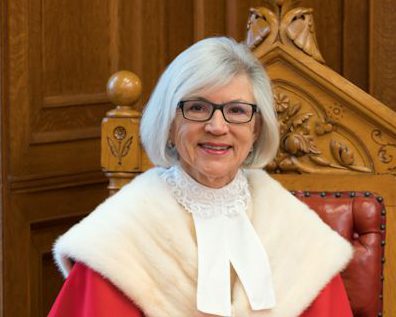
The Justice Centre today released the Judicial Freedom Index, a study which sets out the voting records of 33 Supreme Court of Canada judges in regard to the Charter freedoms of conscience, religion, expression and association.
The study shows that when it comes to defending the fundamental freedoms of Canadians, the record of Chief Justice Beverley McLachlin, who leaves the Supreme Court of Canada this Friday December 15, is better than average.
Since the Charter came into effect in 1982, the Supreme Court has upheld and justified government violations of fundamental freedoms in three fifths of cases. Citizens seeking to protect their freedom of conscience, religion, expression or association under section 2 of the Charter were successful only 40% of the time.
Of the 33 judges who have issued rulings on Charter section 2 fundamental freedoms since 1982, only Justices Louise Arbour, Frank Iacobucci and John Major have stronger pro-freedom voting records than Beverley McLachlin.
“While the Court’s record leaves much to be desired, McLachlin’s record is far better than those of most of her colleagues,” stated Calgary lawyer John Carpay, co-author of the Judicial Freedom Index.
Chief Justice McLachlin’s record on fundamental Charter freedoms of conscience, religion, expression, and association
In split decisions on Charter freedoms, where the Court issued a majority ruling and a dissent, the Court sided with the government in 18 out of 26 cases. The challenger, asserting that Charter freedoms had been violated by a government law, policy or decision, was vindicated in just 8 of these 26 rulings.
While the Court as a whole ruled for the challenger 31% of the time in these split decisions, McLachlin did so 62% of the time.
McLachlin was often a strong supporter of freedom of expression, striking down government violations of this fundamental freedom in 10 of 16 cases in which the court was divided.
In the Taylor, Keegstra and Zundel cases, McLachlin upheld freedom of expression as an indispensable pillar of democracy. She rejected government restrictions on offensive speech, arguing that the terms “hatred” and “contempt” are vague, subjective and emotional, and susceptible to a wide range of meanings; these terms should therefore not be used to restrict public debate on important moral and political issues. However, in the more recent Whatcott decision, McLachlin moved away from some of her previous reasoning, joining a unanimous court to support limits on speech in order to protect favoured groups from discrimination.
In RJR-MacDonald v. Canada, McLachlin struck down a total prohibition on all tobacco advertising as going too far. In UFCW v. KMart Canada, she upheld a union’s right to engage in peaceful information picketing and consumer leafleting at stores not party to the labour dispute. In Harper v. Canada, she rejected Elections Act spending limits that were imposed on individual citizens, as unfairly granting political parties a monopoly on effective expression during an election.
McLachlin’s record in support of religious freedom was less strong. She supported Trinity Western University’s freedom to establish and maintain its own code of conduct for students and faculty, in the face of the BC College of Teachers alleging discriminating, stating “TWU is not for everyone.” But she upheld Alberta’s decision to end the longstanding practice of exempting Hutterian Brethren from the mandatory requirement of having photos on driver’s licenses, and this without evidence that the integrity of the licensing system had been harmed in the preceding 29 years. While rejecting the claim of a Quebec parent that a mandatory “Ethics and Religious Culture” course in public schools violated religious freedom, she also overturned the Education Minister’s decision to impose this course, without modification, on a private Catholic school.
McLachlin’s record on freedom of association was also mixed. She rejected Merv Lavigne’s claim to be exempted from union dues that were spent on political causes he disagreed with. In a different ruling, she stated that the Charter protects a negative right “not to associate,” and that requiring an individual to belong to a union amounts to unjustifiable ideological conformity. She struck down provisions of Quebec’s Referendum Act which required all spending to take place under a “Yes” committee or a “No” committee. In cases where unions challenged government decisions or policies, she ruled for unions 75% of the time, and held that public sector unions have a constitutional right to strike.
Demandes de renseignements des médias: media@jccf.ca
Associated cases
No results found.
Associated News Releases
No results found.